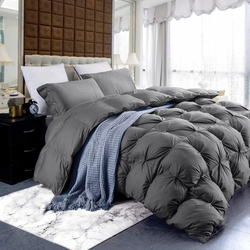

Take any two comforters from a shop and they will appear similar externally. They both have the same white color. They both claim to be fluffy and warm without being heavy. While one of them is available for 120 dollars, the other, a luxurious down comforter, is priced at 800 dollars. And all that is written on its label is stuff like fill power, cluster size, and European goose down.
It does matter. Quite a bit, actually.
People who have slept under a real luxurious down comforter for a few years tend to shrug when someone asks if the price is worth it. The cheap one starts leaking feathers by month six. The expensive one still feels the way it did on day one, five winters later. That gap widens the longer you own each type of comforter.
Here is what separates them.
Fill Power Decides How Warm and How Light
Fill power measures how much space one ounce of down takes up. A higher number means fluffier clusters, more trapped air, and better insulation for less weight.
Cheap comforters sit around 400 to 550 fill power. Mid-range options land near 600. A luxury piece starts at 700 and climbs to 800 or 900.
Why does that matter when you are half asleep at 2 a.m.?
A 600-fill comforter needs a lot more down to keep you warm, which means a heavier blanket pressing on your chest. An 800-fill comforter keeps you just as warm with a fraction of that weight. You get warmth without the suffocating feeling some people describe when they first try synthetic fills.
The Shell Is Not Just Fabric
The shell is the outer covering that holds the down. On a cheap comforter, the shell is usually a low thread count polyester blend or rough cotton that does two annoying things. It lets feathers poke through. And it feels faintly plasticky against your skin after a few washes.
A luxury shell uses long-staple Egyptian cotton, usually in a tight cambric or sateen weave, with a thread count high enough to prevent any down leakage. The fabric breathes. It wicks moisture. It softens with age instead of breaking down.
You notice this when you buy a duvet cover and the comforter underneath starts making crinkly sounds. That is a cheap shell. Real luxury shells make almost no sound at all.
Construction Tells You Who Cut Corners
Open a cheap comforter and look at the stitching. The down is usually held in place with sewn-through channels, which is the fastest and cheapest way to make one. The problem is obvious once you see it. Down collects in the middle of each channel and thins out at the seams, so cold spots form wherever the stitching runs.
A proper down comforter uses baffle box construction. Small fabric walls sit between the top and bottom layers, creating evenly filled boxes that hold down in place without flattening.
This difference shows up on cold nights. A sewn-through comforter has stripes of warmth and stripes of draft. A baffle box comforter feels even across your whole body.
Cluster Size and Source Also Matter
Down comes from two places on a bird. The plumules under the outer feathers are the real down clusters, soft and three-dimensional. Regular feathers are the sharp ones that occasionally poke out of your pillow.
Inexpensive comforters typically contain 60% down and 40% feathers. In some cases, even less. Top-quality comforters can be composed of 90% to 95% down. This type of down contains large clusters because it comes from mature birds.
Another important factor is the source of the down. Down feathers obtained from European white geese in places like Hungary, Poland, or Siberia have large clusters and higher lofts compared to those collected from any other place. This claim is backed up by RDS and IDFL certificates.
You do not see any of this on the shelf. You feel it when you pull the comforter up to your chin, and it puffs back into shape instead of lying flat.
What to Check Before You Buy
Look for these on any down comforter you are considering:
- Fill power of 700 or higher.
- A down-to-feather ratio of 90 percent down or better
- Baffle box construction, not sewn-through
- A cotton shell, ideally long-staple Egyptian cotton
- Responsible Down Standard or IDFL certification
If a listing does not mention fill power, assume it is low. If the label avoids specific numbers, the product has reasons to stay vague.
A luxurious down comforter is not a decorative object. It is a piece of bedding you will sleep under for thousands of nights. The cheap version makes that obvious within a month or two. The real one takes care of the rest quietly, for years, and you stop thinking about it at all.