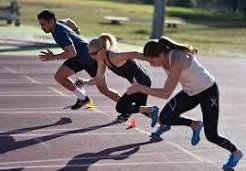

The final 100 metres of a race often appear to be a simple test of who has the most energy left. In reality, the outcome is shaped by decisions made throughout the race. Pacing, positioning, technique, perception of effort, tactical awareness, and the ability to respond under pressure all influence what happens when athletes enter the closing section. Physical fitness matters, but it does not act alone.
The finish also compresses many decisions into a short period, which is why it can feel unpredictable to spectators. Attention shifts from endurance to timing and execution, much as users move toward fast-response formats such as tower rush game online, where each action follows the previous one with little delay. In racing, however, the final result is determined by how well an athlete combines remaining physiological capacity with judgment and movement efficiency.
Pacing Determines What Is Available at the Finish
A runner cannot treat the final 100 metres as an isolated event. The ability to accelerate late depends on how much energy has already been used.
An athlete who runs above a sustainable intensity too early may enter the final section with high lactate accumulation, reduced coordination, and limited ability to increase speed. Another runner with similar aerobic fitness may arrive with more capacity because the earlier pace was better controlled.
This is why two athletes with comparable laboratory measurements can finish very differently. Fitness defines the range of possible performance, while pacing determines how much of that range remains available at the end.
Experienced runners learn to distinguish between discomfort that can be sustained and effort that will cause a large drop in speed. That judgment becomes part of race skill.
Positioning Changes the Cost of the Sprint
The final 100 metres are also affected by where the athlete is positioned when the sprint begins.
In races with multiple competitors, a runner trapped behind others may have the fitness to accelerate but lack space. Moving outside can solve the problem, but it may require extra distance. Waiting for a gap can save ground while creating the risk that the opportunity never appears.
This makes positioning an energy-management issue as well as a tactical one. Athletes often spend energy earlier in the race to secure a better place before the final turn or straight.
The ideal position depends on the event and field. A runner with a strong finish may prefer to remain protected until late, while another may need to move earlier because a short sprint favors competitors with greater top-end speed.
Speed Reserve Matters
A finishing kick depends partly on the difference between an athlete’s normal race speed and maximum sprint speed.
Two runners may be equally fit aerobically but have different speed reserves. If one athlete has a higher maximum velocity, race pace represents a smaller percentage of that maximum. This can provide more room for acceleration near the finish.
For this reason, endurance athletes often include short sprints, strides, hill accelerations, and strength work in training. These sessions are not designed to replace aerobic development. They help maintain the neuromuscular qualities required to increase speed when fatigue is already present.
The final 100 metres therefore depend on the interaction between endurance and speed rather than on endurance alone.
Running Mechanics Deteriorate Under Fatigue
Fatigue changes movement. Ground contact time can increase, posture may collapse, stride frequency can fall, and force production may become less efficient.
Athletes who maintain technique under pressure can preserve speed even when their physiological state is similar to that of competitors around them.
This is one reason the final sprint should be trained under more than one condition. Fresh sprinting develops speed, while fast running after intervals or tempo work teaches the athlete to maintain mechanics when tired.
The goal is not to produce perfect technique in every step. It is to reduce the amount of speed lost when fatigue begins interfering with coordination.
Small mechanical differences can become decisive when several runners enter the final straight together.
Perception of Effort Influences Timing
Athletes do not have direct access to a precise measurement of how much energy remains. They act partly on perception.
During a race, the brain receives information from breathing, muscles, temperature, pain, and previous experience. The athlete then judges whether an increase in pace can be sustained.
Starting the sprint too soon can cause a large decline before the line. Starting too late may leave unused capacity.
The best timing depends on both physiology and experience. Runners who have competed in many races develop a better sense of how long they can sustain a finishing acceleration.
This is also why race simulations are useful. Training can reproduce the fatigue and decision-making demands that are difficult to learn from isolated fitness sessions.
Psychological Commitment Affects Execution
A finishing sprint requires a decision to tolerate more discomfort when the athlete is already fatigued.
Confidence matters because hesitation costs time. A runner who waits for certainty before attacking may lose the moment when an opponent is vulnerable.
Competitive experience can improve this response. Athletes learn that discomfort does not always mean they are incapable of accelerating. They also become better at recognizing when an opponent’s posture, breathing, or stride suggests fatigue.
Psychological commitment does not create energy that does not exist. It influences how efficiently an athlete uses the capacity that remains.
Opponents Change the Final Strategy
The best finishing plan cannot be designed without considering other runners.
A competitor known for a short sprint may encourage others to accelerate earlier. A runner who tends to fade may become a target for pressure before the final 100 metres.
Athletes also react to movement. When one runner begins a kick, others must decide whether to respond immediately, wait, or continue at the planned pace.
Following every acceleration can be costly. Ignoring the wrong move can end the race.
Tactical skill therefore involves identifying which changes in pace matter and which are likely to fail.
The Finish Is Built During Training
The final 100 metres can be improved through specific preparation.
Intervals that finish with an acceleration teach athletes to change speed while fatigued. Strength training supports force production, while sprint work develops speed reserve. Tactical sessions can reproduce crowded positioning and changes of pace.
Coaches may also practice different finishing scenarios. An athlete can rehearse leading into the final straight, attacking from behind, responding to an early move, or waiting for a shorter sprint.
This type of preparation reduces the number of decisions that must be invented during competition.
Fitness Creates Capacity, but Skill Determines Its Use
Physical fitness remains the foundation of the final 100 metres. Without sufficient aerobic and anaerobic capacity, tactical decisions cannot compensate for severe fatigue.
But fitness alone does not determine who reaches the line first.
The closing section depends on what the athlete did earlier, where they are positioned, how much speed reserve remains, whether technique can survive fatigue, and how accurately the runner interprets the race.
The best finishers are therefore not simply the athletes who have the most energy left. They are often the ones who use their remaining capacity at the right moment, in the right position, with enough technical control to convert effort into speed.